
Camera and NIR imaging package
A camera module and optical sensing configuration matched to your installation and driver operating volume, with imaging performance evaluated for precise pupil localization.
Technologies / Precision Eye & Gaze
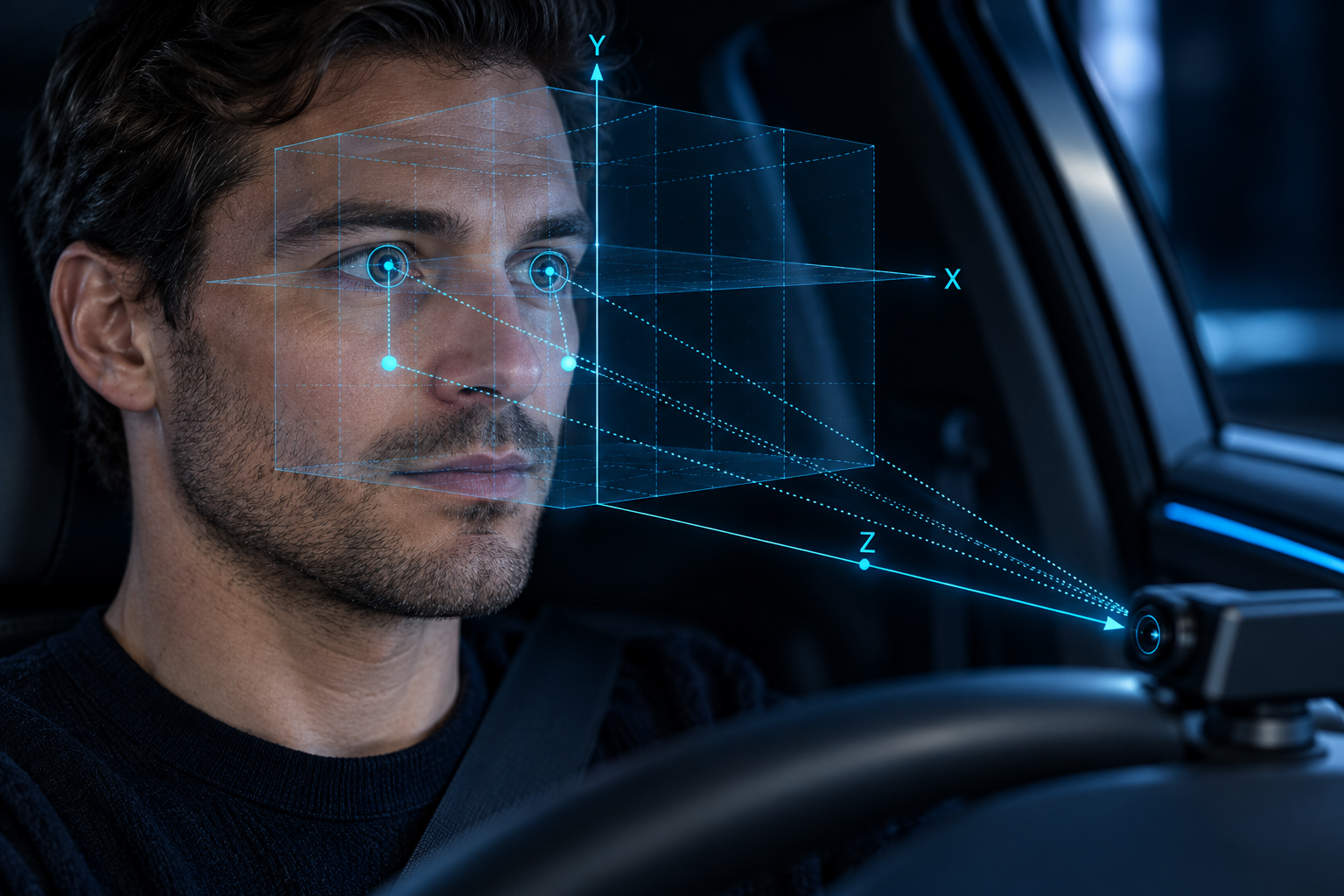
Track the driver’s 3D viewing position as it changes.
An AR-HUD needs to know where the driver’s eyes are. Seating position, posture and head movement change the viewing geometry and affect how virtual information aligns with the road scene.
Mindtronic AI provides 3D pupil positioning to support viewpoint-aware AR-HUD rendering and alignment.
01 / Why AR-HUD needs eye positioning
AR-HUD graphics must appear at the intended location in the driver’s view of the road. An error in the estimated pupil position can shift a virtual marker away from the real object it should highlight. Tracking the driver’s pupils in three dimensions helps the rendering system maintain alignment as seating position, posture and head position change.
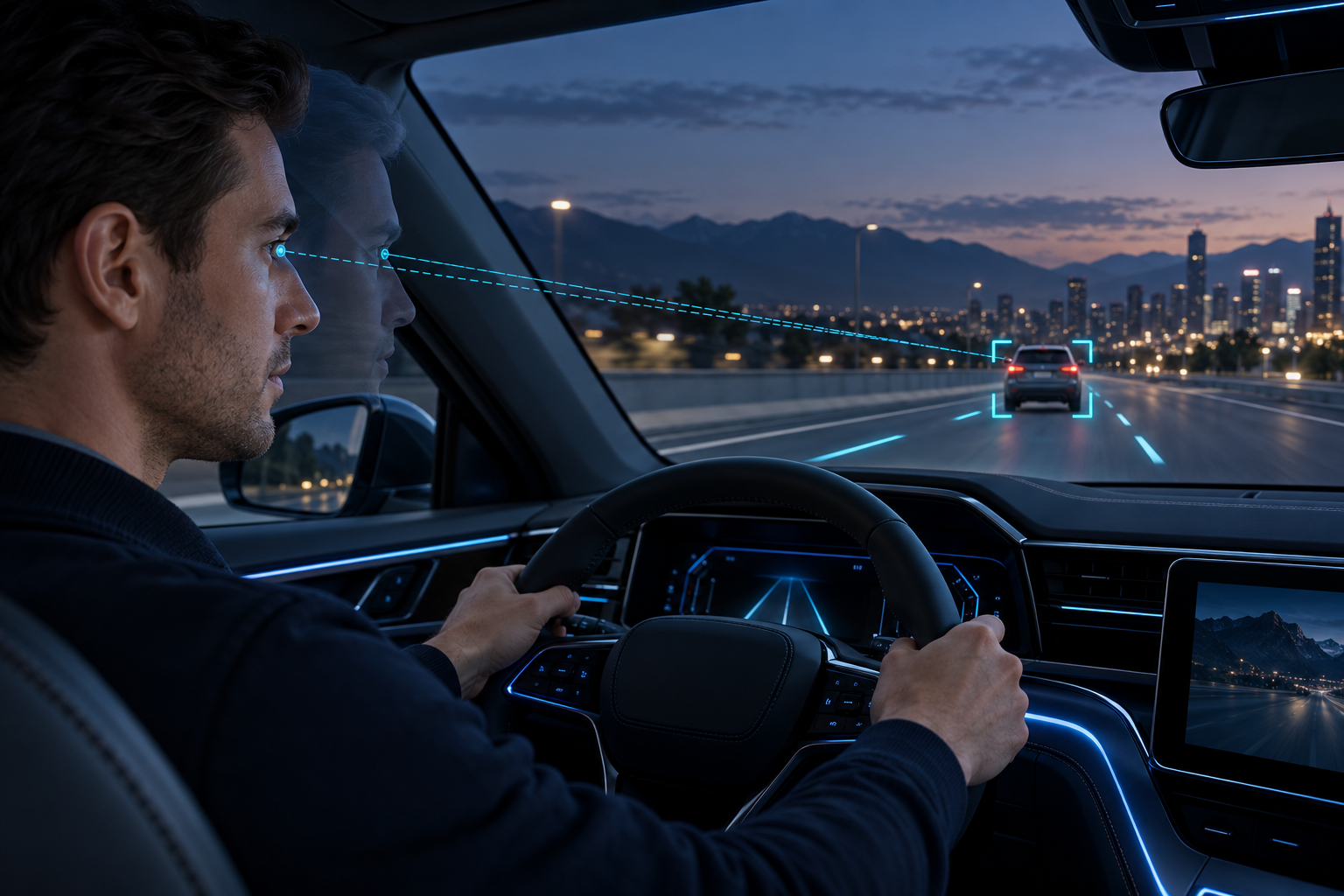
Both describe the driver’s eyes, but their outputs serve different applications. Gaze direction identifies the target of the driver’s attention. 3D pupil positioning supplies the viewing location needed by the HUD’s rendering geometry. Accurate AR-HUD alignment also depends on the HUD optics, rendering and timing of the complete system.
Estimates the direction of attention to associate gaze with a cockpit control or road object.
Explore gaze-driven interaction →Estimates the pupils’ X, Y and Z coordinates so the HUD can render for the driver’s current viewpoint.
02 / MAI offers and deliverables
MAI delivers camera, depth sensing and embedded software as a coordinated positioning system, with ECU options matched to your architecture. Our deliverable is validated, quantifiable and predictable system-level performance within agreed operating conditions. Each component is selected and integrated with its contribution to the complete XYZ positioning and timing budget understood.
A camera module and optical sensing configuration matched to your installation and driver operating volume, with imaging performance evaluated for precise pupil localization.
Depth-sensing hardware and integration configured for the positioning system, with reliability and its contribution to the overall depth error characterized under agreed conditions.
An embedded pipeline delivering pupil localization, XYZ estimates and tracking behavior, with spatial error, availability and end-to-end timing evaluated together.
Integration on your computing platform or an MAI ECU option, with vehicle interfaces and sustained positioning performance assessed on the agreed target hardware.
Program deliverables are agreed with your HUD, cockpit and vehicle teams: the sensing and software configuration, output interfaces, system error budget, performance characterization and validation evidence against the agreed acceptance criteria.
03 / Connect positioning to your HUD
Positioning must be meaningful to the HUD. We work with your team to define coordinate relationships, timing and tracking behavior alongside the sensing hardware.
Define X, Y and Z outputs in an agreed coordinate frame and their relationship to vehicle and HUD geometry.
Agree output timing and latency requirements to support rendering synchronization during driver movement.
Define handling of unreliable or unavailable estimates, temporary occlusion and tracking recovery.
04 / Precision under real vehicle conditions
Accurate image localization is one part of accurate 3D positioning. The complete system must also address depth reliability, movement, vibration and the time required to deliver each estimate to the HUD.
Locate the pupil precisely despite limited eye detail, lighting variation, eyewear and partial occlusion.
Maintain dependable depth positioning in the presence of measurement noise, changing posture and driver movement.
Balance stable coordinates with responsiveness to real head movement and vehicle vibration.
Deliver current position estimates so that processing delay does not undermine the HUD viewing geometry.
Sustain positioning and timing within the target platform’s compute, memory, power and thermal constraints.
05 / Validate the complete positioning system
We define validation around the vehicle program’s spatial, dynamic and integration requirements. Performance is assessed with its operating conditions and measurement methods made explicit.
Evaluate localization and resulting XYZ error across agreed imaging and driver conditions.
Measure depth error, repeatability and tracking availability throughout the agreed operating volume.
Characterize dynamic positioning error, temporary tracking loss and recovery under defined motion and vibration conditions.
Measure output rate and end-to-end latency separately, then assess their contribution to error during movement.
Evaluate sustained performance on the agreed computing platform under representative operating loads.
Assess how sensing, positioning, integration and latency contribute to overall XYZ error. Validate the combined result against the HUD program’s requirements.
Discuss program-specific performance targets, operating conditions and validation results with our engineering team.
06 / Define your AR-HUD positioning program
Bring us your HUD geometry, driver operating volume and positioning requirements. We will work with your team to define the sensing configuration, computing scope, output interfaces and validation plan.